
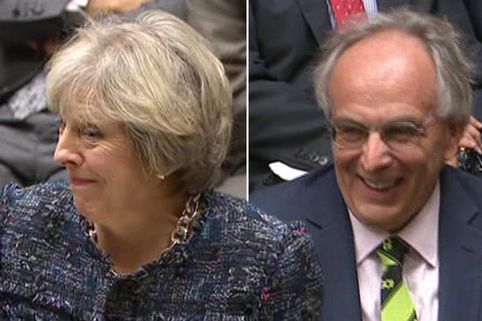

Theresa May today insisted she has won a good deal for Britain and is determined to deliver it as she faced down rebel Cabinet ministers and Tory MPs.
 The Prime Minister mounted another robust defence of the package thrashed out with Brussels despite the rising threat of a no-confidence vote by her own MPs.
In a speech to business leaders, she said the blueprint will allow the UK to regain control of immigration while keeping ties with the EU strong and protecting jobs.
The agreement is a good one for the UK. It fulfils the wishes of the British people as expressed in the 2016 referendum, she said.
Let no one be in any doubt. I am determined to deliver it.
Moving to quell calls from within Cabinet for the deal to be renegotiated, the premier made clear that there is no prospect of reopening the divorce talks – saying the task now was to finalise the future trade framework.
Chief negotiator Michel Barnier said the arrangements that had been painstakingly put together over nearly two years are ‘fair and balanced’ and the UK will be left in full control.
Meanwhile, senior Tory figures have tried to head off a mutiny by MPs, with former chief whip Andrew Mitchell warning that the party would sustain massive damage if they were seen to hunt her down as happened to Margaret Thatcher.
Tory ex-leader Lord Howard also urged rebels to hold off, saying that while he personally opposes the Brexit deal it should be put to Parliament.
In another day of high-drama in the Brexit battle:
Mrs May will today say the divorce arrangements have already been ‘agreed in full’ as she insists her settlement is a good one for the UK.
Addressing the CBI annual conference in London, the Prime Minister said the priority in this ‘intense week of negotiations’ is to ‘hammer out’ the framework of the future trade deal.
She told delegates that her agreement will create a level playing field on immigration that means EU nationals will no longer be able to ‘jump the queue’.
Getting back full control of our borders is an issue of great importance to the British people… once we have left the EU, we will be fully in control of who comes here, she said.
It will no longer be the case that EU nationals, regardless of the skills or experience they have to offer, can jump the queue ahead of engineers from Sydney or software developers from Delhi.
Instead of a system based on where a person is from, we will have one that is built around the talents and skills a person has to offer.
Not only will this deliver on the verdict of the referendum, it should lead to greater opportunity for young people in this country to access training and skilled employment.
The stark message about the options facing Parliament was underlined by EU ministers as they arrived at a Brussels meeting today.
Luxembourg’s foreign minister, Jean Asselborn, said: ‘Boris Johnson once said Britain is leaving the EU, It is not leaving Europe.
I think the challenge now is for these Brexit dogmatists to show whether that is true.
I think Theresa May deserves praise for her position. No deal is better than a bad deal’ has disappeared. Any deal is better than no deal is now the slogan. That is right.
This deal that is now on the table is the best there is. There is no better deal for this crazy Brexit.
As Conservative MPs upped their efforts to for a no-confidence vote, David Davis said he believed over 40 letters have been submitted to Sir Graham, and the numbers seem to be teetering close to getting over the 48.
He also said Mrs May will be the ‘first person’ to find out if he submits a letter.
Backbencher Anne Marie Morris said there was ‘no question’ the threshold of 48 letters would be reached this week.
She told BBC Breakfast that Mrs May has had one of the most difficult jobs’, something she respects her for, but that the Prime Minister is ‘not going to deliver Brexit.
Asked who would deliver for the country if Mrs May is removed, she added: ‘There are lots of new very bright, able people in the party.
My experience is if you name these people, it is always the kiss of death… I think it would be somebody new, somebody from the 2010 or 2015 intake.
I don’t think it will be, dare I say, one of the old guard… I believe people, the general public, want somebody new who is not in a way tainted by all the debate, and the debacle and behaviour of the last few years.
Fellow MP Simon Clarke told the BBC: It is quite clear to me that the captain is driving the ship at the rocks.
But Tory former leader Lord Howard said although he was against the deal, a vote of confidence would be a distraction, telling the Today programme: ‘I don’t think that Members of Parliament should be distracted in the next few weeks by a confidence motion, or a leadership contest which might follow that.
They should be concentrating on the document and its implications.
Mr Mitchell said the party would sustain huge damage if was seen to ‘hunt down’ the PM in the same way it did Thatcher in 1990.
Mrs May yesterday took a swipe at Tory rivals threatening to unseat her as party leader, warning that she was not going to be distracted from the important job of making sure we do get that good final deal for this country.
She argued that a change of leadership would not make it easier to get a deal past Parliament, but would instead create economic instability and put jobs at risk.
In a message to those plotting her downfall, including members of the European Research Group of Eurosceptic MPs led by Jacob Rees-Mogg, she said she had not considered quitting.
She told Sophy Ridge on Sunday: A change of leadership at this point isn’t going to make the negotiations any easier and it isn’t going to change the parliamentary arithmetic.
What it will do is bring in a degree of uncertainty. That is uncertainty for people and their jobs.
What it will do is mean that it is a risk that we delay the negotiations and that is a risk that Brexit gets delayed or frustrated.
Asked if she had considered stepping down, Mrs May said: ‘No, I haven’t. Of course it has been a tough week – actually these negotiations have been tough right from the start – but they were always going to get even more difficult right toward the end when we are coming to that conclusion.’
She added that the next seven days ‘are going to be critical’, and said she would be travelling back to Brussels to talk with key figures including European Commission president Jean-Claude Juncker ahead of an emergency European Council summit on Sunday.
A group of five Eurosceptic Cabinet ministers – Commons leader Mrs Leadsom, environment secretary Mr Gove, international development secretary Penny Mordaunt, transport secretary Chris Grayling and international trade secretary Liam Fox had been expected to gather this morning for breakfast to discuss how to push for changes to Mrs May’s Brexit deal.
However, the meeting is thought to have been dropped.
Dr Fox wrote a supportive article in the Telegraph today urging MPs to get behind the PM. Mrs Leadsom is still on resignation watch as she wrestles with whether she can support the deal.
Meanwhile, Business Secretary Mr Clark has fuelled speculation that the transition period could be extended beyond the mooted end date of December 2020.
The Withdrawal Agreement contains a blank date for when the implementation period could be pushed to if the UK decides to do that rather than enter the Irish border ‘backstop’ arrangements.
Mr Barnier has suggested that the transition could finish at the end of 2022.
Mr Clark said: ‘It would be at our request, and that would be a maximum period.
But it would be for this purpose; it would be if the negotiations are making good progress but haven’t quite been finalised, to have the option and it would be an option for us, if there is value in having the option rather than going in for a temporary period into the backstop, and having a second change, to have the option, if we wanted, if the UK wanted, to extend the transition.
Karen Bradley, one of Mrs May’s closest Cabinet allies, yesterday said the country faced a choice between what she termed the only workable deal that fulfils the will of the referendum, or back to square one on Brexit.
The Northern Ireland secretary added: ‘Clearly, this is a deal that has involved some difficult choices at times, and an element of compromise.
That is an unavoidable fact of negotiations and I accept not everybody is going to agree with every point of detail or choice that we have made.
But it is fundamentally a deal which is in the national interest. It is a deal that will protect jobs, our national security and the integrity of our precious United Kingdom.