
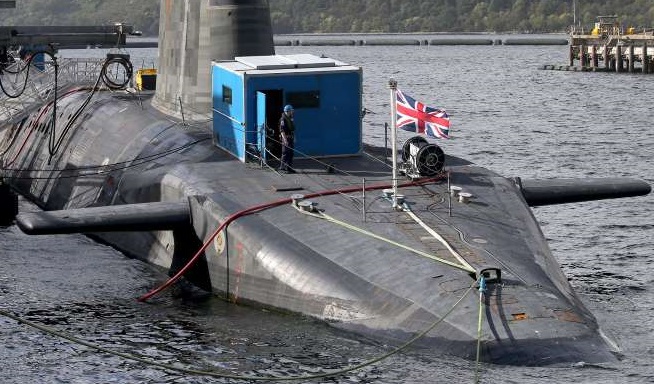

One of Britain’s nuclear deterrent submarines has suffered an unusual amount of damage as pictures emerge of HMS Vengeance returning from patrol with around 30 per cent of her sonar panels missing.
 The ballistic missile submarine returned last week from her latest three-month patrol.
As the nuclear-armed vessel surfaced near the Faslane naval base on the Clyde it was obvious the expected level of wear and tear had been exceeded by up to three times the usual amount.
Britain’s ballistic missile submarines are covered with sonar panels specially designed acoustic shields to mask any sound from inside the submarine and absorb the sound waves of an active sonar emitted by another vessel looking for the boat.
Maybe her replacement wasn’t ready, meaning she had a longer patrol, or she had an incident with fishing nets.
The Royal Navy’s submarine force, known as the Silent Service, has maintained at least one nuclear-armed submarine at sea for 50 years.
Known as Continuous At Sea Deterrence (CASD), the on-duty submarine will leave the Faslane naval base in Scotland with an escorting frigate, then dive to conduct a patrol. The boat will be under the water for three months without surfacing, ready at all times to launch a nuclear strike if ordered to do so.
The boat will patrol at a walking pace and will emit no sound whatsoever in order to remain hidden.
Only a small number of people on board will know where the submarine is at any time and it is not unusual for the crew to place their hands against the outer casing to try to gauge the temperature of the water so as to guess where they might be.
The V-boat fleet started to enter service in the early 1990s with an anticipated life span of 25 years. However, the replacement date has been pushed back a number of times and the next generation of boats carrying Britain’s nuclear deterrent – known as the Dreadnought class is not expected in service until the 2030s.