
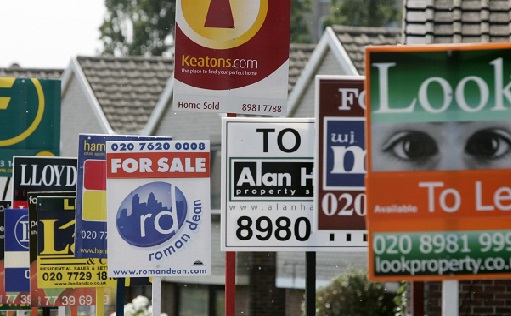

House price growth ground to a halt in during January, with property values showing close to zero growth for the year as Brexit uncertainty hit confidence.
 House prices edged up by just 0.1 per cent year on year in January, the smallest annual increase for the index for almost six years, and a sharp decline from 1.9 per cent growth in November, Nationwide said.
As recently as January 2017, annual house price growth was running at 4.3 per cent.
A no-deal Brexit would see house prices slump a further 5 per cent in 2019, according to predictions from Howard Archer, chief economic adviser to the EY ITEM Club.
Conversely, if a deal is agreed by March, prices could rise by 2 per cent, Mr Archer said.
Bank of England governor Mark Carney told MPs in September that a disorderly Brexit could cause house prices to plummet as much as 35 per cent amid spiralling interest rates and falling demand.
Robert Gardner, Nationwide’s chief economist, said the housing market has improved slightly for buyers.
Indicators of housing market activity, such as the number of property transactions and the number of mortgages approved for house purchase, have remained broadly stable in recent months, but forward-looking indicators had suggested some softening was likely.
In particular, measures of consumer confidence weakened in December and surveyors reported a further fall in new buyer inquiries towards the end of 2018.
While the number of properties coming on to the market also slowed, this doesn’t appear to have been enough to prevent a modest shift in the balance of demand and supply in favour of buyers in recent months.
He continued: Near-term prospects will be heavily dependent on how quickly this uncertainty lifts, but ultimately the outlook for the housing market and house prices will be determined by the performance of the wider economy – especially the labour market.
The economic outlook remains unusually uncertain.
Howard Archer, of the EY Item Club said: If Brexit is delayed, ongoing uncertainty is likely to weigh down on the housing market and could well see house prices stagnate or fall slightly.
Samuel Tombs, chief UK economist at Pantheon Macroeconomics, said: The uncertainty created by Brexit largely is responsible for the further decline in year-over-year growth in house prices to near-zero, from a broadly stable rate of about 2 per cent in the 18 months before November.