
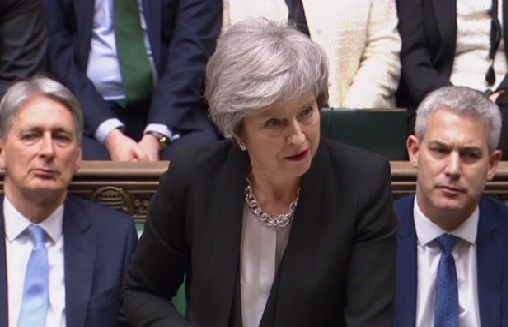

Theresa May faces a clash with Brussels after the House of Commons backed her efforts to rewrite her own draft Brexit treaty, an attempt to break the deadlock at Westminster.
 The prime minister said she would never stop battling for Britain but, while her move rallied Brexiter Conservatives, it has been rejected by Brussels, which has repeatedly stated that the withdrawal agreement cannot be reopened.
Two weeks after her Brexit deal was overwhelmingly rejected by parliament, Mrs May bowed to intense pressure from Eurosceptic Conservatives by agreeing to seek its dismantling. She urged MPs to give her a mandate to return to the fray in Brussels with only two months to go until Britain’s scheduled exit.
The backstop is meant to prevent the return of a hard Irish border, but is strongly opposed by Eurosceptic Tories who fear it would bind the UK in close ties with the EU in perpetuity.
Donald Tusk, the European Council president, flatly rejected Mrs May’s gambit. He said EU leaders remain committed to the existing Brexit agreement painstakingly negotiated over the course of nearly two years.
The backstop is part of the withdrawal agreement, and the withdrawal agreement is not open for re-negotiation, said Mr Tusk’s spokesman. The Irish government issued a nearly identical statement.
Mrs May told MPs after the vote that a basis for a secure and stable majority had been established in the Commons for a Brexit deal that would include changes to the backstop and new guarantees to maintain workers’ rights.
The prime minister admitted to mocking Labour laughter to only limited appetite in Brussels for rewriting the deal. She added: Negotiating it will not be easy. But she said MPs had expressed clearly what they needed to approve a deal. She told MPs that she would seek either a unilateral exit mechanism or a time limit for the backstop.
Both have already been rejected by the EU. Jean-Claude Juncker, European Commission president, is expected to say more on Wednesday afternoon.
Despite the apparent collision course between Brussels and London, an effort by a cross-party group of MPs to delay the date of Brexit failed. An amendment put forward by Labour’s Yvette Cooper that sought to give parliament the power to legislate a delay in leaving the EU was rejected by 321 to 298.
An optimist would look at the silver lining we finally have a plan, noted foreign exchange analysts at RBC Capital. A pessimist would expect the inevitable clash with the EU.
Mr Tusk’s spokesman said the EU was ready to consider delaying the divorce process beyond March 29. Should there be a UK reasoned request for an extension, the EU27 would stand ready to consider it and decide by unanimity, the spokesman said.
A separate amendment by the former Tory minister Dominic Grieve, designed to give MPs the opportunity to back different Brexit options, was rejected by 321 votes to 301. However, another amendment by former Conservative minister Caroline Spelman criticising a no-deal Brexit was approved by 318 votes to 310.
Although MPs voted symbolically against a no-deal Brexit on Tuesday, they did not impose a legal obligation on Mrs May. Asked whether the government’s policy was still to take the UK out of the EU without a deal, if none can be agreed by March 29, the Brexit secretary Steve Barclay on Wednesday told the BBC, Yes, it is.
If the EU continues to hold out against reopening the 585-page treaty, Mrs May will come under pressure from pro-EU MPs in mid-February to stop the clock and seek an extension to the Article 50 divorce process.
Mrs May announced that if she cannot reach a deal with the EU by February 13 an extremely ambitious timetable she would allow MPs another vote on the Brexit progress. That is seen as high noon for those Tories who want to rule out a no-deal exit.
Despite the EU’s reluctance to reopen the treaty, it has indicated greater appetite to discuss the accompanying political declaration between the two sides on future relations or issue clarification letters.
If the UK’s intentions for the future partnership were to evolve, the EU would be prepared to reconsider its offer and adjust the content and the level of ambition of the political declaration, said Mr Tusk’s spokesman.
But Mrs May told MPs she was seeking not a further exchange of letters but a significant and legally binding change to the withdrawal agreement that she negotiated with the EU over two years.
Mrs May also endorsed a plan, put forward by Brexiter Conservatives and pro-EU Tories, to seek alternative arrangements to replace the backstop based on technological solutions. Brussels has repeatedly said that such technology does not exist.
The proposal, led by housing minister Kit Malthouse, also makes provision for a managed no-deal Brexit if no agreement with the EU can be reached, with a phased departure lasting until 2021. The pro-Brexit Tory European Research Group led by Jacob Rees-Mogg favours the plan.
Mrs May set out her new approach to European Commission president Jean-Claude Juncker in what British officials called a “fairly cordial” 10-minute phone call, in which the EU chief again ruled out any reopening of the treaty.
Downing Street admitted Mrs May still feared that if Britain tried to reopen the deal it could see the EU make its own demands on Britain, including on fisheries and Gibraltar.
Meanwhile there were signs from the ERG that even if Brussels did reopen the withdrawal agreement, Eurosceptic Tories could demand more. Steve Baker, a former Brexit minister, said the backstop is only the worst problem.